Sarah Jons | Therapy & Breathwork
Sarah Jons
Phobias and Flying Anxiety
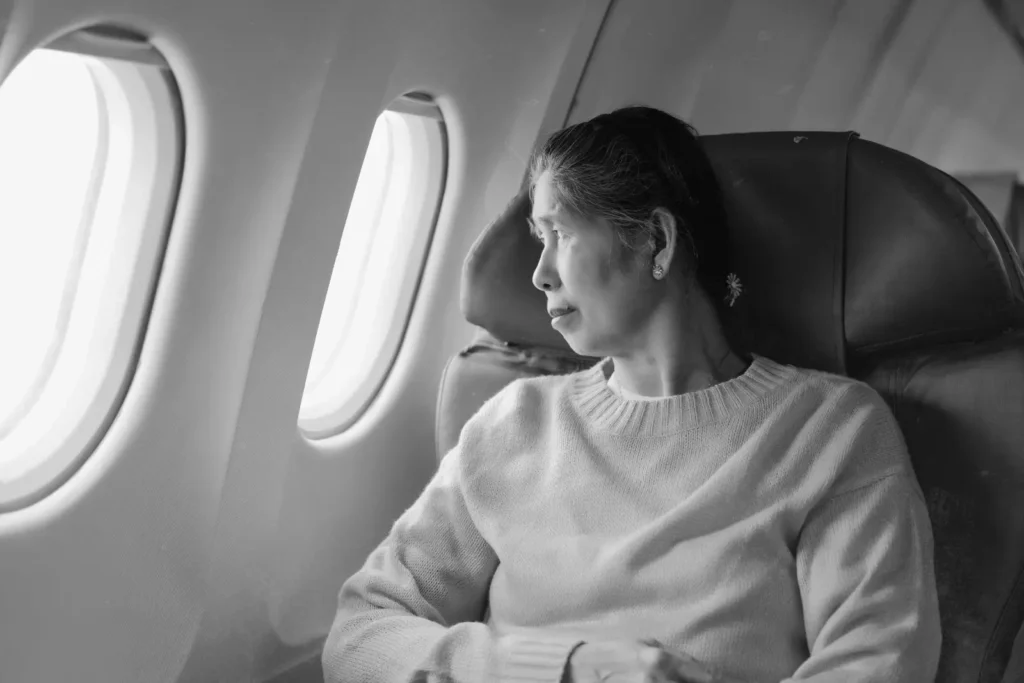
Phobias and flying anxiety are common. Even people who look totally fine can have their body hit the panic button: racing heart, shaky legs, nausea, tunnel vision, intrusive “what if” images.
This isn’t you being dramatic. It’s a threat response. Your nervous system is trying to keep you safe, it’s just misfiring.
This page is a supporting page. The wider approach sits on my Therapy page.
Sessions: online worldwide and in person in London (Barbican & Bounds Green).
Work with me + pricing | Send an enquiry
What I help with
- Flying anxiety (before and during flights)
- Needle/medical phobias, blood tests, injections
- Lift/tube/bridge fears, enclosed spaces, panic sensations
- Emetophobia (fear of vomiting), food and nausea loops
- Phobias in children and teens (including flying)
- Avoidance, over-planning, safety behaviours and ‘what if’ spirals
How the work works
Some phobias are very specific (needles, flying, lifts, vomiting, dogs). Some are broader (panic in crowds, health fears, “what if I lose control”).
Either way, the pattern is usually:
trigger → body alarm → avoidance/safety behaviours → short-term relief → stronger alarm next time
You don’t need to “push through”. You need your system to stop treating the situation like it’s life or death.
- Hypnotherapy to reduce the automatic threat response
- Body-based regulation to bring arousal down fast (no intensity for the sake of it)
- Imagery and future rehearsal (so your system expects the situation without melting)
- Practical exposure steps that are doable, not heroic stunts
- For kids: story-based, simple tools, and parent support where useful
I’m not here to force you into exposure or give you a breathing technique and call it a day. We work with the loop underneath the fear.
In simple terms:
- Calm the system (so we’re not trying to “fix” anything from threat).
- Map the fear programme (sensations, images, predictions, safety behaviours).
- Update it using subconscious work (hypnosis) plus rehearsal/exposure steps that actually fit your life.
Flying anxiety: we can rehearse the whole sequence (booking → airport → take-off → turbulence → landing) so your nervous system has a new script.
Children & teens: I’ve worked with kids around flying many times. It’s gentler, more imaginative, and usually includes simple parent support so the tools get used in the real world.
What sessions are like
Phobias are one of the places where exposure-based approaches have the strongest evidence. The problem is: when your body is already panicking, “just expose yourself” can turn into another failure loop.
As a cognitive hypnotherapist, I use hypnosis as part of a structured, evidence-informed therapy approach. Research suggests clinical hypnosis can reduce anxiety symptoms, particularly when it’s integrated into psychological treatment rather than used in isolation (e.g., Rosendahl et al., 2024; Kirsch et al., 1995).
Translation: we calm the physiology, update the threat predictions, and practise the new response in the contexts that matter.
You’ll usually leave with:
- a clearer map of your fear loop (trigger → body → behaviour)
- one or two regulation tools that actually work for you
- a simple plan for rehearsal/exposure between sessions
- less dread in the lead-up, and more choice in the moment
FAQs
It depends. If it’s one upcoming flight or one specific phobia, we can often do focused work. If it’s been there for years, generalised, or tied into wider anxiety, it can take longer. We’ll be straight about it.
No. We work with what your system is doing now. If old material shows up, we handle it carefully, but there’s no “you must relive it” approach here.
Yes. Online works well for phobias and flying anxiety because the work is mostly about state, imagery, prediction and rehearsal. For kids, online can work too if they’re comfortable and there’s a parent nearby for support.
No. Relaxation can help, but phobias are usually a threat prediction problem. We’re updating the prediction and the body response, then practising it in the situations that matter.
If you’ve got a flight coming up, or a fear that’s started shrinking your life, we can work with the response underneath it.
This can be especially relevant if you’re trying to manage symptoms without certain medications, for example during pregnancy or when you’re TTC, where your GP or midwife may advise changes. We focus on nervous-system regulation and subconscious patterns, so you’ve got something practical to lean on.